




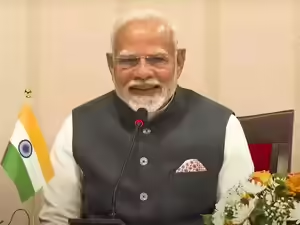
India’s Prime Minister Narendra Modi will arrive in Namibia on July 9, marking the first visit by an Indian Prime Minister to the country since its independence in 1990.
The visit comes at the invitation of President Netumbo Nandi-Ndaitwah and is seen as a key diplomatic move to strengthen ties with the mineral-rich Southern African nation.
The trip is the final leg of Modi’s five-nation tour and underscores India’s foreign policy priorities: securing critical mineral supply chains, expanding energy cooperation, and exporting digital infrastructure to partners in the Global South.
Namibia is home to large reserves of uranium, lithium, cobalt, rare earth elements, and marine diamonds—minerals that are vital to India’s plans for electric vehicles, semiconductors, clean energy, and defence industries. With demand for such materials expected to triple by 2030, India is eager to diversify its sources and reduce reliance on just a few countries.
“We see Namibia as more than just a supplier,” said Dammu Ravi, Secretary (Economic Relations) at India’s Ministry of External Affairs. “Africa’s mineral wealth aligns with India’s clean-tech goals.”
Modi is expected to discuss long-term frameworks for exploration, mining, and supply of these critical minerals during talks with the Namibian leadership, alongside encouraging Indian investments in Namibia’s mining sector.
The uranium partnership is also back on the table. Namibia is among the world’s top three uranium producers and is crucial to India’s civilian nuclear energy expansion.
Although India and Namibia signed a uranium supply agreement in 2009, little progress followed. With growing domestic demand for clean base-load power and the need for reliable nuclear fuel, Modi’s visit is expected to revive discussions on establishing a structured uranium supply arrangement.
Diamonds will be another focus area. India is the world’s largest centre for cutting and polishing diamonds, but much of its supply passes through trading hubs like Antwerp and London.
Namibia holds over 80 million carats of high-quality marine diamond reserves but typically exports its rough stones via intermediaries.
Modi’s trip aims to explore direct diamond export channels to India, reducing costs and creating value for both countries.
Several Indian diamond processing companies already operate in Namibia.
Digital cooperation will also take centre stage. A key highlight of the visit will be the official launch of India’s Unified Payments Interface (UPI) in Namibia.
Earlier this year, the Bank of Namibia and NPCI International signed an agreement to pilot UPI, making Namibia one of the first African countries to adopt the system.
Modi is expected to formally roll out the platform, reinforcing India’s push to share its Digital Public Infrastructure (DPI) with partner nations.
The integration is aimed at boosting financial inclusion and enabling low-cost transactions, strengthening India’s position as a technology partner in the Global South.
Beyond trade and energy, Modi’s agenda includes new agreements in healthcare, education, and defence cooperation.
A Centre of Excellence in IT is being set up in Windhoek to train Namibian youth and civil servants in digital governance and cybersecurity. Defence discussions are expected to cover officer-level training, logistics support, and non-lethal technology exchanges.
The visit also carries deep symbolic weight. India and Namibia have long enjoyed strong political ties dating back to India’s support for Namibia’s freedom movement in the 1980s. India was among the first countries to advocate for Namibia’s independence at the United Nations.
During his visit, Modi will address a joint session of Namibia’s Parliament, emphasising the shared democratic values and historical bonds between the two countries.
He will also pay homage to Dr Sam Nujoma, Namibia’s founding President and revered liberation leader.
This State Visit will be especially significant for President Nandi-Ndaitwah as it marks the first time she welcomes a head of state since assuming office.
Bilateral trade between India and Namibia was valued at around USD 650 million in 2023. Indian exports include pharmaceuticals, rice, and petroleum products, while imports feature diamonds, uranium, and non-ferrous metals. Indian investments in Namibia have already surpassed USD 800 million, with expectations of further growth in sectors such as energy, fintech, and logistics.


