




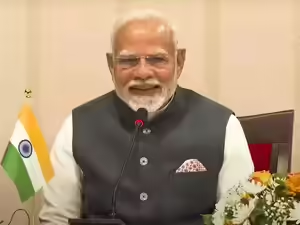
Prime Minister Narendra Modi will visit Namibia on July 9, 2025, as part of his five-nation tour of Africa and Latin America, marking the first visit by an Indian prime minister to the southwestern African country.
While Indian presidents have visited Namibia in the past, including President Shankar Dayal Sharma in 1995 and President Pranab Mukherjee in 2016, this will be the first such visit at the prime ministerial level.
According to The Economic Times, the visit aims to strengthen cooperation in the diamond trade, mining of critical minerals, and uranium supply.
Namibia is one of the world’s largest uranium producers and is seen as a reliable source to help meet India’s growing nuclear energy needs.
Diamonds are a key area of trade between the two countries.
Namibia has some of the richest marine diamond deposits in the world, with estimated reserves exceeding 80 million carats.
Indian firms have established a strong presence in Namibia’s diamond processing sector.
Companies such as Ankit Gems Namibia and KGK Diamonds Namibia operate cutting and polishing facilities in Windhoek, where they process rough stones that typically arrive in India through trading hubs like London and Antwerp.
According to Namibia’s Ministry of Mines and Energy, other licensed diamond processors with Indian links include Finestar Jewellery and Diamonds Namibia, Schachter & Namdar, Tate Diamonds, Yaelstar Namibia, and Brilliant Star Diamonds.
These companies are part of a diamond industry that supports local jobs while also feeding India’s vast diamond-cutting and jewellery sector.
Beyond diamonds, India is looking to expand cooperation in critical minerals needed for the energy transition.
Namibia has geological potential for new mining projects in cobalt, lithium, and rare earth elements—minerals essential for electric vehicle batteries and renewable energy technologies.
Government-backed Indian firms such as Khanij Bidesh India Ltd (KABIL) have a mandate to secure supplies of critical minerals from overseas, including African partners. While no formal investment deals have yet been announced in Namibia’s critical minerals sector, discussions are expected during the visit.
Uranium is also high on the agenda. Namibia’s Husab and Rössing mines are among the world’s largest uranium producers.
India is seeking to secure stable uranium supplies through long-term agreements, complementing existing contracts with other producing countries.
Overall, Indian investments in Namibia are estimated to exceed US$800 million.
These cover not only mining and diamond processing but also manufacturing, infrastructure, ICT, pharmaceuticals, and services.
Modi’s visit is expected to focus on expanding this investment footprint and signing new cooperation agreements.
Indian officials hope to streamline supply chains for Namibian rough diamonds, formalise arrangements for uranium supply, and develop partnerships in critical minerals.
The visit reflects India’s broader strategy of strengthening ties with African countries to secure access to vital resources, support economic development, and build long-term trade relationships.


