




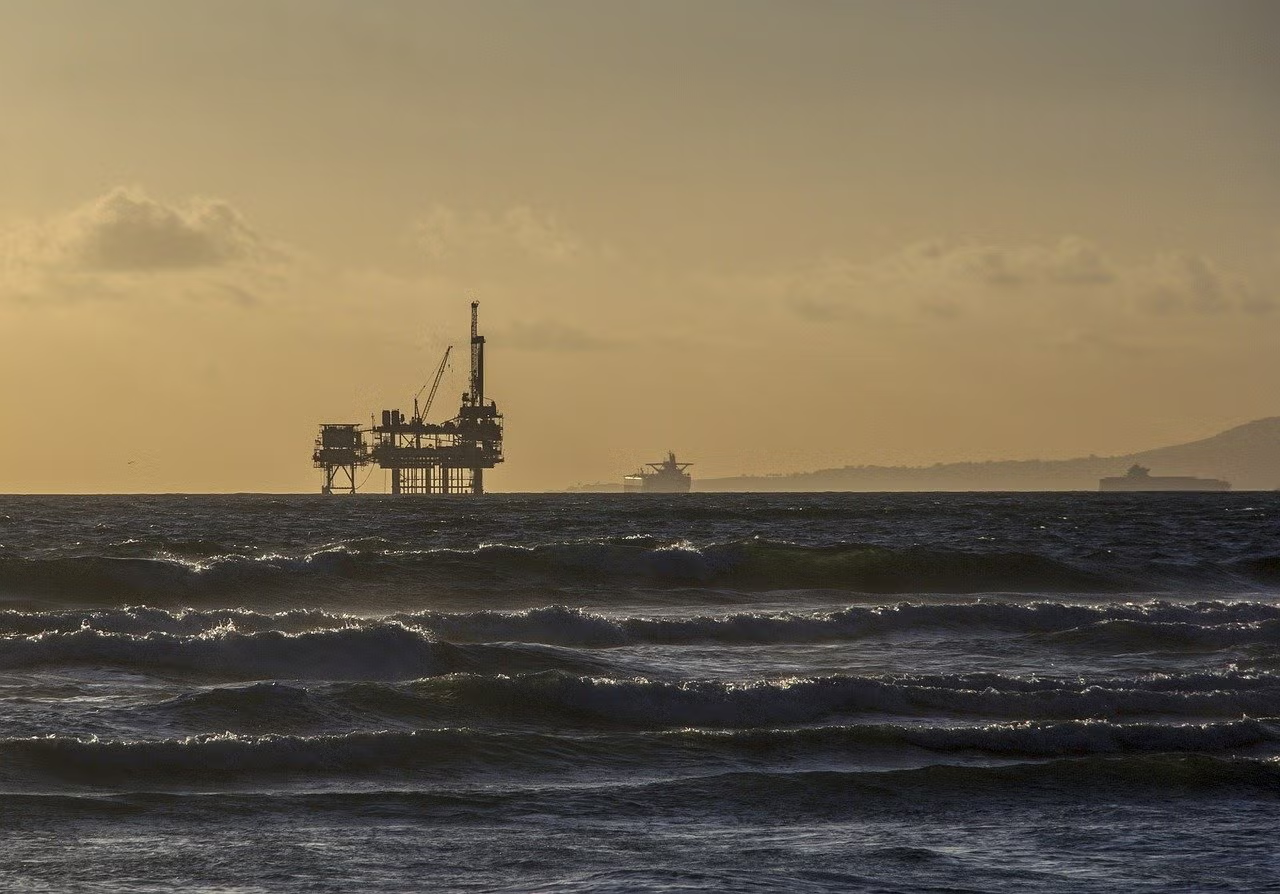
When TotalEnergies’ drill bit struck oil in the deep waters of Namibia’s Orange Basin in early 2022, the global energy industry took notice.
The discovery—named Venus—was immediately hailed as one of the most significant ultra-deepwater finds of the decade.
Three years later, its environmental and social impact assessment paints a picture of a technically ambitious, long-lived, and economically transformative venture that could reshape Namibia’s economy for generations.
According to the 3 November 2025 ESIA by SLR Environmental Consulting, Venus is designed to operate for more than 25 years, with oil production expected to run for 21 years and possibly another decade depending on reservoir performance.
The project sits some 300 kilometres off Oranjemund, in water depths approaching 3,000 metres, where up to 40 subsea wells—half for production and half for gas injection—will feed a massive floating production, storage and offloading vessel.
Once production begins, about 600 direct jobs, 600 indirect, and an impressive 5,800 induced jobs are expected to be created, most concentrated in logistics and engineering around Lüderitz and Walvis Bay.
For Namibia—a country with no history of large-scale oil production—the scale of Venus is unprecedented. But how does this new frontier compare to the rest of the world’s great offshore discoveries?
Deepwater parallels: Venus and Brazil’s Tupi
The closest parallel lies across the Atlantic in Brazil’s Santos Basin. There, Petrobras’ Tupi field—discovered in 2006 beneath thick layers of pre-salt rock—proved that ultra-deepwater oil could be produced at a commercial scale.
Like Venus, Tupi lies in waters around 2,000 to 3,000 metres deep and required pioneering subsea technology and floating platforms.
Tupi’s recoverable reserves were estimated at five billion barrels of oil equivalent—roughly the same ballpark TotalEnergies geoscientists have hinted at for Venus. The Brazilian project transformed its host economy: spawning domestic shipyards, engineering firms, and a web of supply industries that now employ tens of thousands.
Venus could play a similar role for Namibia, albeit on a smaller scale.
With local-content policies taking shape and new training funds pledged through Petrofund and the University of Namibia, the project’s socio-economic reach could extend far beyond the rig floor—if the country succeeds in replicating Brazil’s careful blend of industrial policy and foreign partnership.
Lessons from the giants: Safaniya and Kashagan
On the scale of the world’s significant oilfields, Venus is still modest. Saudi Arabia’s Safaniya field, discovered in 1951, remains the largest offshore oil deposit on Earth, with recoverable reserves exceeding 37 billion barrels.
It has operated continuously for more than seventy years and underpinned the industrial base of the Gulf region.
Yet Safaniya is a shallow-water environment, low risk compared to Venus’s abyssal setting. Namibia’s field belongs to the league of ultra-deep, high-cost, high-reward operations—projects that depend on advanced subsea robotics, remote operations, and delicate well integrity systems three kilometres below the surface.
Closer in spirit to Venus is Kazakhstan’s Kashagan field in the Caspian Sea—another technically demanding frontier discovered in 2000.
Kashagan contains about 13 billion barrels of recoverable oil but became infamous for its delays and costs, with development spending surpassing US$50 billion before first production in 2013.
Harsh operating conditions, high sulphur content, and logistical bottlenecks plagued the project for years, offering a cautionary tale for newcomers: frontier riches require patience, discipline, and strong regulation.
Namibia’s turn at the frontier
For Namibia, the difference lies in timing and governance. Unlike early frontier producers that stumbled through opaque contracts and weak environmental oversight, Venus is unfolding in an era of scrutiny and standards.
Its ESIA models every conceivable risk—from a gas injection line rupture releasing 267,000 m³ of gas once off, to a full-scale well blowout lasting 13 days—and ranks them by probability and consequence.
Modelling suggests that oil from such an event would drift northwest, away from the coast, with a negligible shoreline impact under a 90 per cent likelihood.
A nearshore spill, however, could spread hundreds of kilometres along the coast, underscoring the need for the project to adhere to MARPOL standards and implement a tiered oil-spill contingency plan.
A decommissioning trust fund will also be established midway through the field’s life to ensure cleanup and closure are fully funded.
These layers of planning place Venus within the best global practice for offshore operations—an approach TotalEnergies has refined through decades of experience in Angola, Nigeria, and Brazil. But what makes Venus distinctive is its national context: a young, fast-growing energy economy where a single discovery can lift GDP, diversify exports, and reshape the labour market.
Scale, lifespan, and impact
In pure numbers, Venus may not match the giants of the Gulf or the Caspian. Yet it stands shoulder to shoulder with Brazil’s Tupi, Guyana’s Liza, and other 21st-century frontier discoveries that opened new provinces to the world.
A field life exceeding 25 years, 40 subsea wells, and an FPSO designed to operate autonomously in 3,000 metres of water make it one of Africa’s most sophisticated offshore systems.
The induced job creation of nearly 6,000 positions—along with scholarships, training, and regional development funds—points to broad social benefits that extend beyond the oil barrels themselves.
If managed wisely, Venus could do for Namibia what Tupi did for Brazil: trigger a generation of skills transfer, infrastructure investment, and confidence that a small nation can master the world’s most challenging frontiers.
The story of Venus is therefore not just about oil. It is about Namibia stepping onto the global energy stage—measured not against its size, but against its ambition.


