



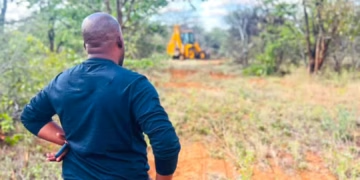



Andrada Mining has confirmed a nine-kilometre mineralised pegmatite system extending to depths of nearly 300 metres at its Lithium Ridge project in Namibia’s Erongo Region.
The company released its sixth and final batch of Stage 1 drilling results on 24 November 2026, concluding a 16,525-metre diamond drilling campaign comprising 143 holes funded by SQM International, one of the world’s leading lithium producers.
The results confirmed multiple stacked pegmatites containing high-grade lithium alongside persistent tin and tantalum mineralisation, supporting the potential development of a mining operation capable of generating revenue from three commodities.
The drilling programme was initially designed to cover 14,000 metres but was expanded by 18% to investigate the continuity of mineralisation at greater depths, structural thickening and newly mapped parallel pegmatites beyond the main ridgeline.
The final batch reported mineralised pegmatite intersections from 59 drill holes, providing additional geological information for exploration targeting, resource modelling and further development of the project.
Andrada chief executive officer Anthony Viljoen said the results demonstrated the scale, grade and structural continuity of the mineralised system.
“The release of the final batch of Stage 1 drill results marks a defining milestone for the Lithium Ridge project and our strategic partnership with SQM. Across 143 diamond drill holes comprising over 16,500 metres of core, our exploration team has been able to demonstrate the scale, grade, and structural continuity of a mineralised pegmatite system that extends for some 9km along strike.”
High-grade lithium near surface and at depth
The highest-grade lithium sub-interval in the final batch was recorded in drill hole LRD049, which returned 15.94 metres grading 2.20% lithium oxide from a downhole depth of 57.26 metres, including 2.96 metres at 3.07% lithium oxide.
The broader intersection also contained 0.16% tin and 75 parts per million (ppm) tantalum.
Another shallow intersection, in drill hole LRD047, returned 27.19 metres grading 1.08% lithium oxide, 0.15% tin and 58 ppm tantalum from 17.57 metres.
Drilling also confirmed substantial mineralisation at greater depths, with hole LRD126 returning 24.17 metres grading 1.30% lithium oxide from 264.58 metres, including eight metres at 1.67% lithium oxide.
Hole LRD113 returned 32.19 metres at 0.92% lithium oxide from 256.47 metres, including 4.71 metres grading 1.58% lithium oxide.
Another significant intersection, in hole LRD124, returned 32.07 metres grading 1.02% lithium oxide, 0.13% tin and 53 ppm tantalum from 137.24 metres.
“These final assays close out the drilling campaign on a high note delivering shallow, high-grade lithium intersections, while simultaneously proving that wide, well-mineralised pegmatites, some exceeding 30 metres in apparent width, persist to depths approaching 300 metres,” Viljoen said.
Andrada said the presence of multiple stacked, sub-parallel mineralised pegmatites supports the potential for bulk open-pit development in the upper sections of the mineralised system, while deeper intersections indicate that mineralisation remains open at depth.
The company cautioned that the reported intersections represent apparent widths rather than the true thickness of the mineralised bodies.
Three potential revenue streams
The drilling programme also confirmed widespread tin and tantalum mineralisation across the mining licence, potentially allowing Andrada to recover multiple critical minerals from a single operation.
Significant tin and tantalum intersections included 0.53 metres grading 1.41% tin and 374 ppm tantalum in hole LRD052, which also returned a separate intersection of 3.67 metres grading 0.41% tin and 136 ppm tantalum.
Hole LRD089 returned 2.06 metres grading 0.79% tin, while hole LRD106 intersected 2.56 metres grading 768 ppm tantalum.
Other notable results included 3.12 metres grading 594 ppm tantalum in hole LRD048 and 5.59 metres grading 0.27% tin and 381 ppm tantalum in hole LRD142.
Viljoen said Andrada could draw on its existing operational and metallurgical expertise at the nearby Uis mine.
“Equally compelling is the persistent tin and tantalum mineralisation across the licence. Leveraging Andrada’s established operational and metallurgical expertise from our nearby Uis Mine, the potential to produce multiple critical minerals from a single operation could significantly enhance future project economics.”
The company said the production of multiple revenue-generating commodities could improve the project’s economics and effective operating cost position, although this remains subject to further metallurgical testing and economic evaluation.
Defining the mineralised system
Seven drill holes either failed to intersect significant pegmatites or returned mineralisation below Andrada’s minimum reporting criteria of more than 0.25% lithium oxide, 0.1% tin or 99 ppm tantalum.
Rather than focusing exclusively on high-grade intersections, the drilling programme also sought to establish the structural and geological boundaries of the mineralised pegmatite system.
Andrada said the peripheral drilling results would allow its technical team to refine the three-dimensional geological model, strengthen geological confidence and improve future exploration targeting and resource modelling.
Sample preparation was undertaken by SA Labs Ithuba, while chemical analyses were conducted by UIS Analytical Services.
The technical findings and quality assurance and quality control procedures were reviewed by Professor Laurence Robb, who has more than 30 years of industry-related exploration and economic geology experience.
SQM’s US$7 million investment
Lithium Ridge is situated on mining licence ML133, approximately 35 kilometres southeast of Andrada’s flagship Uis mine, and is connected by road to the B2 highway in the Erongo Region.
The licence lies within the NaiNais-Kohero pegmatite belt and encompasses the historical TinTan mine.
The project is held by Grace Simba Investments and is being developed through a three-stage earn-in agreement between Andrada and SQM.
Under Stage 1, SQM funded US$7 million in exploration expenditure to earn an initial 30% interest in Grace Simba Investments, with the programme overseen by a joint development committee comprising equal representation from both companies.
The completion of the 143-hole drilling campaign provides the partners with a comprehensive technical dataset to support further development of Lithium Ridge.
Although the results establish the scale and continuity of the mineralised system, further metallurgical testing and economic evaluation will be necessary to determine the commercial viability of producing lithium, tin and tantalum from a single mining operation.


