

• Home
  • News
  • Magazine
    • Current Edition
    • Previous Editions
  • Climate
  • Minerals
  • Mining
  • All About Namibia’s Extractive Sector
  • Contact
  • Menu Item
Monday, November 23, 2026
  • Login
The Extractor Magazine
  • Home
  • News
    • All
    • Africa
    • Biofuels
    • Climate
    • Copper
    • Exploration
    • Lithium
    • Minerals
    • Mining
    • Namibia
    • Nickel
    • Oil & Gas
    • PIPELINES
    • Precious Metals
    • RIGS & VESSELS
    • Silver
    • Uranium
    Giyani secures US$2.5m for K.Hill manganese project in Botswana

    Giyani secures US$2.5m for K.Hill manganese project in Botswana

    Namibia mining output falls 17% as Chamber warns of further contraction

    Namibia mining output falls 17% as Chamber warns of further contraction

    Huaye recruits 40 workers for Khoemacau expansion in Botswana

    Huaye recruits 40 workers for Khoemacau expansion in Botswana

    Skeleton Coast Uranium raises C$3.56m for Namibia exploration

    Skeleton Coast Uranium raises C$3.56m for Namibia exploration

    Sweet Thorn Pan puts Serval’s Botswana copper ambitions to the test

    Sweet Thorn Pan puts Serval’s Botswana copper ambitions to the test

    Aldoro deploys two rigs for 1,930m copper-gold drilling at Kalkfeld

    Aldoro deploys two rigs for 1,930m copper-gold drilling at Kalkfeld

    Haib placed third among major low-grade copper producers

    Haib placed third among major low-grade copper producers

    Okavango Diamond Company earns US$645 million from Botswana diamond sales

    Okavango Diamond Company earns US$645 million from Botswana diamond sales

    Jacaranda reports A$7.3 million cash to fund Botswana gold exploration

    Jacaranda reports A$7.3 million cash to fund Botswana gold exploration

    Verity gets approval for 100-t copper-silver sampling at Airstrip and Dibete in Botswana

    Verity gets approval for 100-t copper-silver sampling at Airstrip and Dibete in Botswana

    Trending Tags

  • Magazine
    • Current Edition
    • Previous Editions
  • Climate
  • Minerals
  • Mining
  • All About Namibia’s Extractive Sector
  • Contact
  • Menu Item
No Result
View All Result
The Extractor Magazine
No Result
View All Result
Home Magazine

Namibia’s long road to mineral beneficiation

by Editor
November 5, 2025
in Magazine
0
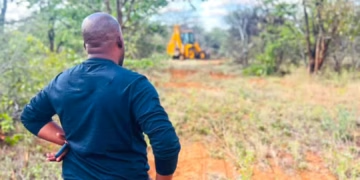
Otjikoto Gold Mine still has some life worth 198,142 ounces of gold
624
SHARES
1.8k
VIEWS
Share on FacebookShare on Twitter

Less than 10 per cent of Namibia’s mineral exports are processed domestically, a figure that underscores both the country’s mineral wealth and its industrial gap.

While mining remains the backbone of the economy—contributing about 13.3 per cent to GDP in 2024—most ores leave the country unrefined, costing Namibia thousands of jobs and billions in lost value.

In 2021, the Ministry of Industrialisation and Trade drafted the Mineral Beneficiation Strategy (MBS) to change that picture.

The plan was designed to transform Namibia from a raw-materials exporter into a regional processing and manufacturing hub.

It identifies priority value chains where Namibia already has a comparative advantage: base metals (copper, zinc, lead), uranium, diamonds, dimension stone and semi-precious stones, and the critical-minerals cluster, which includes tin, tantalum, lithium, germanium, and gallium.

The strategy aligns with the Green Industrialisation Blueprint (2024/25) and National Development Plan 6 (2025-2030), both of which call for deeper industrial linkages between mining, manufacturing, and energy.

The government’s stated goal is to raise the share of processed mineral exports from about 46 per cent—essentially diamonds—to 57 per cent by 2030, while creating 15,000 to 20,000 industrial jobs in downstream sectors.

Building value at home

At the centre of the beneficiation drive is the push to develop Special Economic Zones (SEZs) and industrial corridors with dedicated power, water, and logistics infrastructure.

These are intended to attract refineries, metal fabricators, and component manufacturers that can operate near Namibia’s mines and ports.

The Tsumeb Smelter conversion—now owned by Sinomine Resource Group—is an early anchor project, shifting the ageing copper plant toward multi-metal processing and recycling of critical minerals such as germanium and gallium.

The investment, estimated at more than US$220 million, is one of the first concrete demonstrations of the policy’s intent.

Farther south, Skorpion Zinc is pursuing a refinery-conversion feasibility study to restore Namibia’s domestic zinc-processing capacity and eventually supply refined products to the Southern African market.

Other initiatives, such as Andrada Mining’s lithium-tin-tantalum operation at Uis and Arcadia Minerals’ Swanson Tantalum Project, are exploring local beneficiation routes for battery-metal concentrates.

These projects feed into the MBS’s broader objectives: expanding the tax base, localising supplier networks, and enabling Namibian MSMEs to participate in new manufacturing and service chains linked to the mining industry.

Obstacles to progress

Despite its promise, the beneficiation strategy has been slow to take off. Several challenges persist:

Policy alignment: The MBS must dovetail with the pending Minerals Bill, the SEZ framework, and evolving local-content rules.

Unclear timelines and overlapping mandates between ministries have slowed execution.

Infrastructure gaps: Smelting and refining require reliable power and water supplies.

Namibia’s electricity tariffs remain among the highest in the region, while desalination and rail infrastructure are still under development.

Finance and bankability: Downstream projects are capital-intensive. Investors demand long-term feedstock security, predictable tariffs, and regulatory stability before committing to billion-dollar plants.

Skills shortages: Namibia has a capable cadre of geologists and mining engineers, but a limited pool of metallurgists, process engineers, and industrial chemists—the very expertise needed to run beneficiation facilities.

Institutional capacity: Key agencies, including the Ministry of Mines and Energy and the Ministry of Environment, continue to face delays in processing permits and environmental clearances, adding uncertainty to project timelines.

Despite the obstacles, the beneficiation policy remains a cornerstone of Namibia’s industrial agenda. It is the mechanism through which the government hopes to double the mining sector’s GDP contribution by 2035, embed domestic value-addition industries, and diversify exports away from raw materials.

If successful, Namibia could evolve from a supplier of unprocessed ore into a regional producer of refined metals, alloys, and battery-material feedstocks.

This position would attract global investment as countries seek transparent, sustainable sources of critical minerals.

For now, the policy is more blueprint than reality. But as major projects like Tsumeb, Skorpion, and Uis expand under the banner of beneficiation, the foundation is forming. Namibia’s next chapter in mining will depend not on what it extracts from the ground, but on how much value it can keep above it.

Share250Tweet156
Editor

Editor

  • Trending
  • Comments
  • Latest
Private company led by John Sisay to revive Tschudi, Otjihase, Matchless and Berg Aukas mines  

Private company led by John Sisay to revive Tschudi, Otjihase, Matchless and Berg Aukas mines  

February 6, 2024
Namibia’s next multi-mineral growth province

Celsius Resources targets June deal for Opuwo Cobalt-Copper project sale

May 25, 2026
ReconAfrica to drill first well in the Damara Fold Belt after raising N$238m

ReconAfrica to drill first well in the Damara Fold Belt after raising N$238m

April 3, 2024
Askari Metals puts hopes on Kestrel Pegmatite within the Uis Lithium Project

Askari Metals puts hopes on Kestrel Pegmatite within the Uis Lithium Project

3
Namibia holds 26 million ounces of silver

Namibia holds 26 million ounces of silver

3
2024 HOPEFULS: Langer Heinrich’s return after five years

2024 HOPEFULS: Langer Heinrich’s return after five years

2
Giyani secures US$2.5m for K.Hill manganese project in Botswana

Giyani secures US$2.5m for K.Hill manganese project in Botswana

November 23, 2026
Tsodilo secures two-year renewal for Gcwihaba rare earth project in Botswana

Tsodilo secures two-year renewal for Gcwihaba rare earth project in Botswana

November 23, 2026
Namibia mining output falls 17% as Chamber warns of further contraction

Namibia mining output falls 17% as Chamber warns of further contraction

November 23, 2026
  • Home
  • News
  • Magazine
  • Climate
  • Minerals
  • Mining
  • All About Namibia’s Extractive Sector
  • Contact
  • Menu Item

Copyright © 2023 The Extractor Magazine. | Powered by: Impeccable Tech & Designs

No Result
View All Result
  • Home
  • News
  • Magazine
    • Current Edition
    • Previous Editions
  • Climate
  • Minerals
  • Mining
  • All About Namibia’s Extractive Sector
  • Contact
  • Menu Item

Copyright © 2023 The Extractor Magazine. | Powered by: Impeccable Tech & Designs

Welcome Back!

Login to your account below

Forgotten Password?

Retrieve your password

Please enter your username or email address to reset your password.

Log In

Subscribe now to receive all mining sector and related news!

You have successfully subscribed to the newsletter

There was an error while trying to send your request. Please try again.

The Extractor Magazine will use the information you provide on this form to be in touch with you and to provide updates and marketing.
Subscribe